August 27-28, 2026
2026 Lunar Eclipse in Los Angeles: Visibility & Local Times
See when and where to watch the August 27-28, 2026 partial lunar eclipse in Los Angeles, including local times, Moon altitude, direction and cloud forecast.
This is a deep partial lunar eclipse, not a total lunar eclipse. At maximum, about 93% of the Moon's diameter enters Earth's dark umbra.
Viewing plan for Los Angeles
Only part of the eclipse is above the horizon here.
 Partly visible
Los Angeles has a partly visible view of the August 2026 deep partial lunar eclipse. The table below converts every phase to local time and calculates the Moon's position for the city center.
Local eclipse timeline
| Local eclipse timeline | Local time | Moon altitude | Direction |
|---|---|---|---|
| Penumbral eclipse begins | Thu, Aug 27, 06:24 PM PDT | Below horizon | 95° E |
| Partial eclipse begins | Thu, Aug 27, 07:34 PM PDT | 2.7° | 104° ESE |
| Maximum eclipse | Thu, Aug 27, 09:13 PM PDT | 21.3° | 119° ESE |
| Partial eclipse ends | Thu, Aug 27, 10:52 PM PDT | 37.2° | 140° SE |
| Penumbral eclipse ends | Fri, Aug 28, 12:02 AM PDT | 44.6° | 160° SSE |
Countdown to penumbral eclipse
Viewing weather
Forecast becomes available up to 16 days before the event.
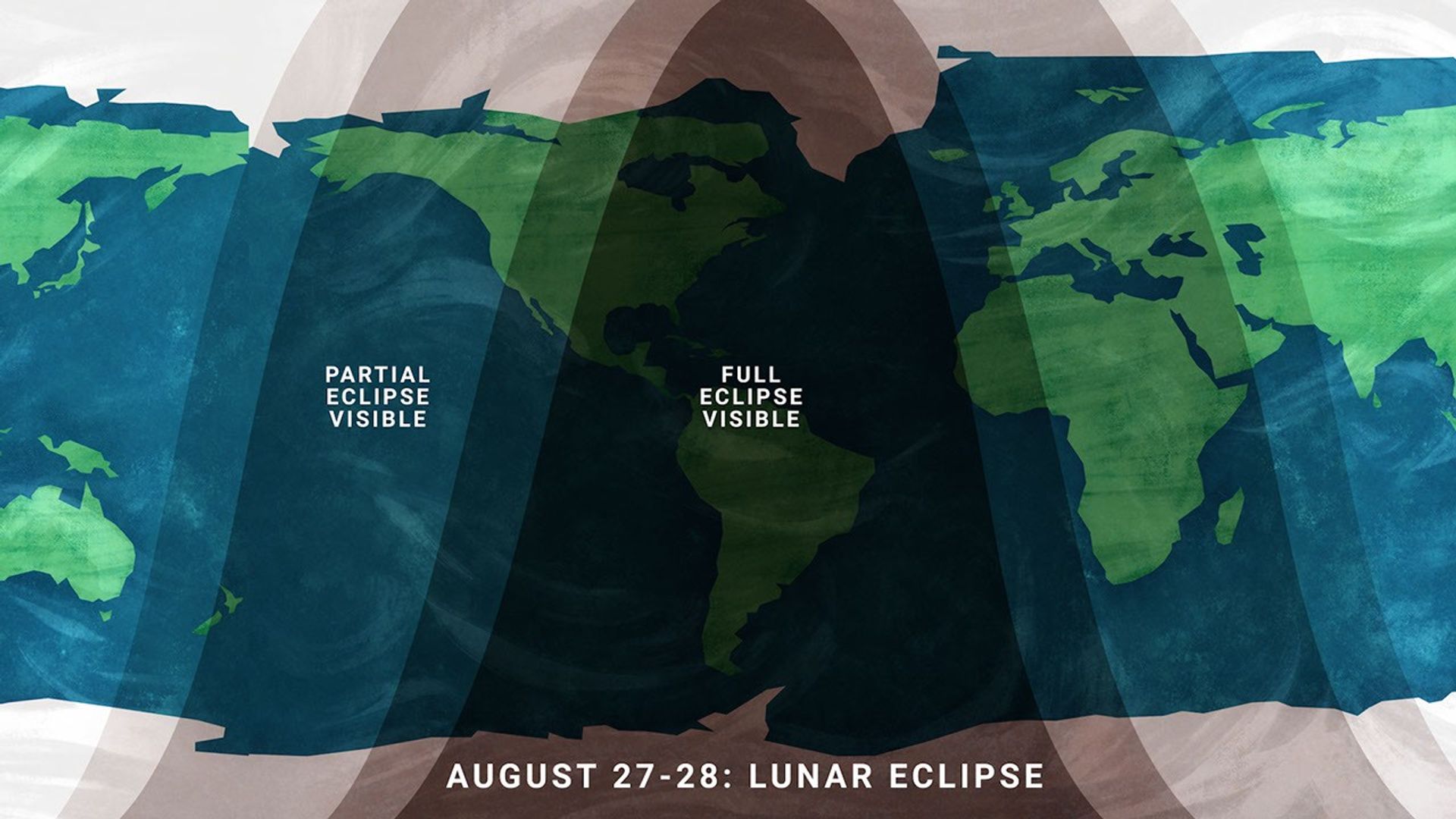
Where the eclipse is visible
All partial phases are visible across much of the Americas. Europe and Africa see only part of the event as the Moon sets.
2026 eclipse facts
- Type
- Deep partial lunar eclipse
- Umbral magnitude
- 0.9299
- Greatest eclipse
- 04:13 UTC
- Eye safety
- Safe to view directly
How to watch and photograph it
- No eye protection is required for a lunar eclipse.
- Find an open western horizon and arrive at least 20 minutes early.
- On a phone, use a tripod, lock focus on the Moon and lower exposure.
- With a camera, start near ISO 400, 1/125 s and f/8, then bracket exposures.
Popular city guides

Frequently asked questions
Is this a blood moon?
It may look coppery or reddish near maximum, but astronomically it is a deep partial lunar eclipse, not a total lunar eclipse.
Do I need eclipse glasses?
No. Lunar eclipses are safe to view directly with your eyes, binoculars or a telescope.
Why are local times different?
The eclipse happens at the same moment worldwide. This tool converts each phase from UTC into the selected city's time zone.